
Case study · Energy & Infrastructure · South Africa
Green hydrogen investment evaluation: capital allocation and logistical risk.
A financial and logistical audit of a proposed green hydrogen facility with approximately R4 billion in planned capital expenditure identified export-cost, water and energy constraints before further investment. The supplied scenario indicates an approximately R9.6 billion annual operating deficit at full output; this is a modelled risk, not a verified loss avoided or money recovered.

Business Optimisation Specialist · Nemico Consulting
The strategic catalyst: every audit begins with a question
Why commit approximately R4 billion to hydrogen production before testing export economics, water availability and electricity requirements together?
A promising production-cost estimate can conceal an unviable supply chain. This pre-development audit tested whether the proposed selling price could cover production, liquefaction and intercontinental transport—and whether the upstream resources could support the intended output.
The challenge: production is only one part of the system
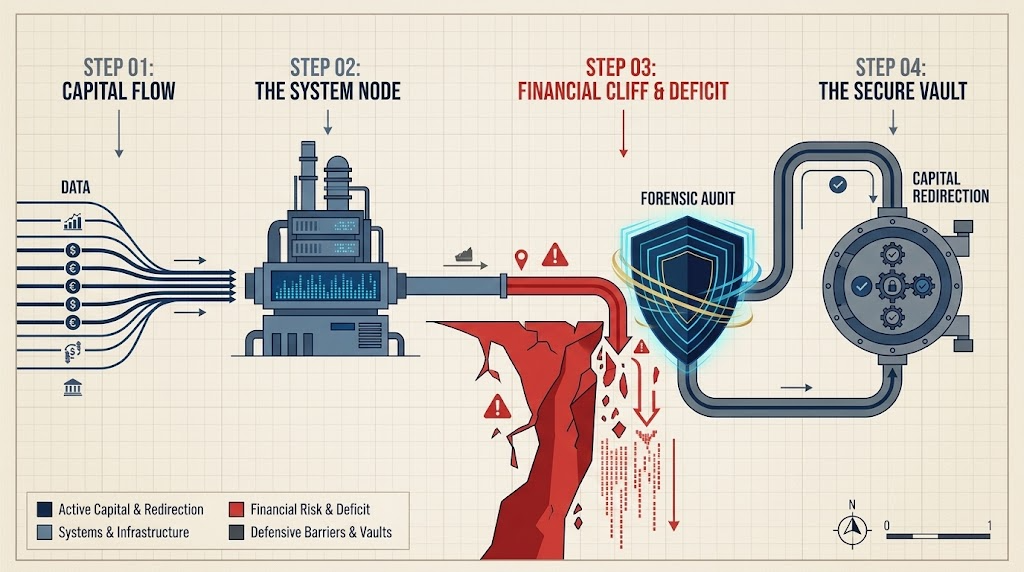
- Export unit economics: the supplied model uses R38.40/kg selling value, R28.00/kg production cost and a further R120.00/kg for liquefaction and transport. Including logistics changes the apparent margin into a projected operating deficit.
- Water availability: at 240,000 kg of hydrogen per day and the assumed 9 litres/kg, the stoichiometric requirement is 2.16 million litres daily. The source reports only approximately 131,500 litres per day under the initial allocation scenario.
- Electricity demand: at an assumed 51.77 kWh/kg, electrolysis alone requires approximately 12.42 million kWh daily—an average continuous load of approximately 517.7 MW. Renewable generation, storage, grid access and additional process loads need their own engineering assessment.
The intervention: test viability before deploying capital
- Phase 1 — Correct unit economics: include downstream costs and advise pausing further capital commitments until the commercial model is validated. Assess domestic off-take or local pipeline options rather than assuming export is the only route.
- Phase 2 — Align water supply: assess lawful, reliable supply against the modelled 788.4 million litres annual requirement before committing infrastructure capital. Confirm licensing, treatment, cooling and other plant water needs separately.
- Phase 3 — Validate energy infrastructure: obtain a site-specific power design, generation profile, storage strategy and cost model matched to operating hours and the intended production rate.
- Governance: tie each investment milestone to validated off-take, unit economics and resource access—not headline revenue or industry enthusiasm alone.
Scenario calculation · Not verified financial recovery
Financial exposure and assumptions
| Measure | Basis / assumption | Modelled value |
|---|---|---|
| Selling price | Source scenario; not a current off-take quotation | R38.40 per kg |
| Production cost | Source scenario; before export logistics | R28.00 per kg |
| Liquefaction and export transport | Source scenario; requires route-specific validation | R120.00 per kg |
| Combined modelled cost | R28.00 + R120.00 | R148.00 per kg |
| Modelled operating deficit | Combined cost less R38.40 selling price | R109.60 per kg |
| Annual output assumption | 240,000 kg per day × 365 days | 87.6 million kg |
| Projected annual operating deficit | 87.6 million kg × R109.60 | Approximately R9.60 billion |
- The supplied prices are assumptions, not independently verified current market benchmarks. The annual deficit excludes separately unmodelled financing, tax, downtime and other costs. It is distinct from the approximately R4 billion planned capital expenditure.
- The document’s USD equivalents imply R20/USD; this scenario retains its rand figures without presenting that exchange rate as current. Its separate chart labelled “USD/MW” does not reconcile with the per-kilogram inputs and is not used here.
- The 9 litres/kg water figure is a stoichiometric basis, not the facility’s total water demand. The reported 4-hectare and 66-hectare allocation descriptions cannot establish lawful water volume without the underlying licence and allocation basis.
- The source’s counts of 477 wind turbines or over 6,200 solar units lack equipment ratings and capacity-factor assumptions. They are not presented as validated infrastructure requirements.
The outcome: risks made visible before investment
The supplied narrative reports that the audit exposed export-cost and upstream-resource constraints and recommended a pause and commercial reassessment before further capital deployment. The advisory work redirected attention from constructing a plant to validating a viable hydrogen supply chain.
No board resolution, revised licence, off-take contract or post-audit financial record accompanies the supplied study to independently confirm investment cancellation, implementation or a quantified loss avoided. The R9.6 billion figure therefore remains a projected annual operating deficit—not a recovery or an achieved financial result.
Before you invest, test the whole supply chain.
Nemico’s paid diagnostic verifies findings and develops a practical plan. Research and planning take 2–3 weeks; the flat fee is quoted after your discovery call.